The GLOW peptide has several origin stories
The blend sounds tidy. Its research history is wonderfully untidy: blood, stomach juice, cultured tendon cells and a protein that is longer than TB-500.
Copper peptide skin research began with cells
The 1988 collagen paper contains an appealing surprise: the GHK sequence is also part of collagen itself. The authors proposed that it might serve as a local wound signal. I like that connection because it ties a proposed repair signal to the material being repaired, rather than to a beauty claim. It remains a proposal.
In cultured human dermal fibroblasts, the cells that help build connective tissue, GHK-Cu stimulated collagen synthesis at concentrations starting at 10^-12 to 10^-11 M, with the maximum effect at 10^-9 M. The effect did not depend on an increase in cell number. More collagen was made; the result was not simply a count of more cells.
Then the 2000 fibroblast experiment complicates the easy story that copper just builds collagen. GHK-Cu also stimulated MMP-2, an enzyme involved in breaking down the surrounding matrix, alongside TIMP-1 and TIMP-2, which inhibit that breakdown. Repair involves clearing as well as making. I think this balance is more interesting than calling the molecule a collagen booster.
A much later 2024 study of aged lung fibroblasts tested GHK and reported restored migration and changes associated with resolving excess scar-forming cells. Lung fibroblasts in culture are a different setting again. That paper concerns fibrosis; younger-looking skin remains untested there.
Cream supplies the human skin result
The 2015 GHK review describes the facial-cream study in 71 women with photoaged skin. Over 12 weeks, it reports increased density and thickness, reduced laxity, better clarity and reductions in fine lines and wrinkle depth.
I give this study a particular place because it concerns people and a visible skin outcome. It still used topical GHK-Cu. There was no BPC-157 or TB-500 blend, and no combined injection. The review leaves the trial concentration unspecified; the general formulation range leaves that gap open.
The 2018 review of gene-expression findings covers a much broader cellular landscape. The scale of that landscape can sound impressive, but it measures gene expression rather than wrinkles. Those two kinds of result answer different questions.
BPC-157: a surprisingly busy gastric fragment
BPC-157 is synthetic, based on part of a protein found in gastric juice. Its repair literature ranges far beyond the stomach. The rat Achilles experiment reported improved biomechanics, function and tissue organization after a complete tendon cut. The tendon-cell experiment examined outgrowth, survival and migration; the growth-hormone-receptor study found increased receptor expression in rat tendon fibroblasts grown in culture.
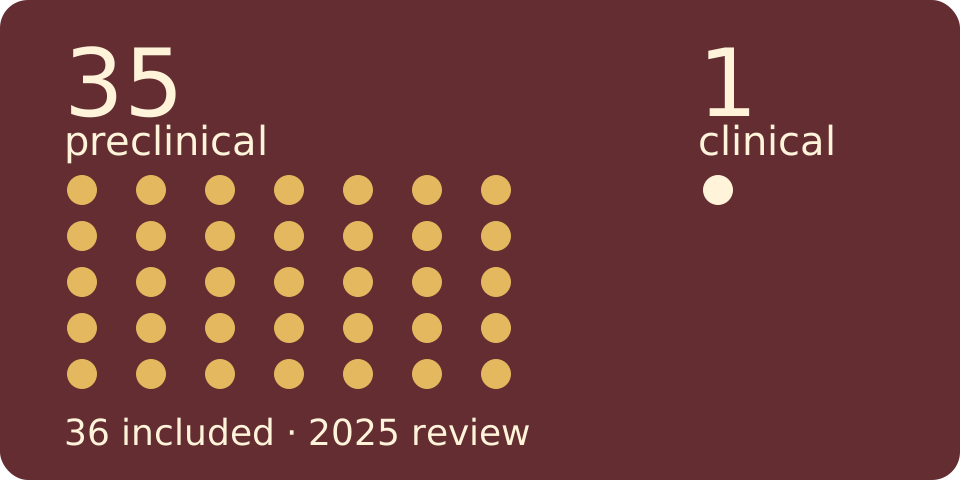
I originally mistook this breadth for a breadth of human experience. The 2025 systematic review makes the imbalance hard to miss: 36 studies, 35 preclinical and 1 clinical. Much of the foundational work also comes from one research group and its collaborators, with limited replication by unrelated teams. Consistency within a research lineage deserves attention, but it leaves a different question from confirmation across many laboratories.
The vascular work is unusually concrete. In isolated aortic rings from adult male rats, BPC-157 produced concentration-dependent relaxation; at 100 µg/mL, relaxation was approximately 48.3%. The paper connects the effect to nitric-oxide signaling in vessel-lining cells. An isolated ring widening in a dish gives a measurable vascular result; its relevance to treating a human tendon remains unproven.
The 2025 distant-organ study examined lower-extremity ischemia-reperfusion injury in rats: damage associated with blood supply returning after restriction. It reported less liver, kidney and lung injury with BPC-157. The 2024 intestinal-anastomosis review concerns surgically joined bowel segments in rats, while the 2026 tissue-repair and pain review draws together further preclinical work. A narrower claim with a stronger human comparison would impress me more.
Counting the human seats
The review’s tally is a useful interruption to the abundance of BPC-157 results. Its 35 preclinical studies and 1 clinical study describe the included evidence; the tally is limited to the papers selected for that review. Preclinical includes work in cells or animals before human trials.
I object to making the volume of animal experiments stand in for the human comparison that has not arrived.
TB-500 fragment and full thymosin beta-4
Full thymosin beta-4 has 43 amino acids. TB-500 is a synthetic fragment of residues 17–23. The 1999 rat wound paper tested the full protein and reported faster re-epithelialization, enhanced collagen deposition and angiogenesis, or the formation of new blood vessels. Its keratinocyte-culture work also found increased cell migration.
The 2004 wound and follicle paper and 2015 genetically altered mouse study likewise concern thymosin beta-4. Even the cardioprotection review concerns the full protein’s preclinical record. None of these titles becomes a TB-500 trial by being mentioned beside the fragment.
I am fussy about this attribution because the substitution changes the substance being credited as well as its spelling.
GLOW peptide stack: the missing joint experiment
The proposed mechanisms make a combination sound plausible: collagen and matrix remodeling, vascular effects, and cell migration. That is a reason to ask about a blend, rather than evidence of synergy.
Neither the combination of BPC-157 and TB-500 nor the complete GLOW formulation has a controlled human trial in this record. Published compatibility data for the three-part mixture are also absent. A trial of the actual formulation, with measured human comparisons, could persuade me. Its proposed mechanisms cannot supply that missing result.
The benefit claims look different once these attributions are made. The FAQ on composition deals with what a blend name can and cannot specify.